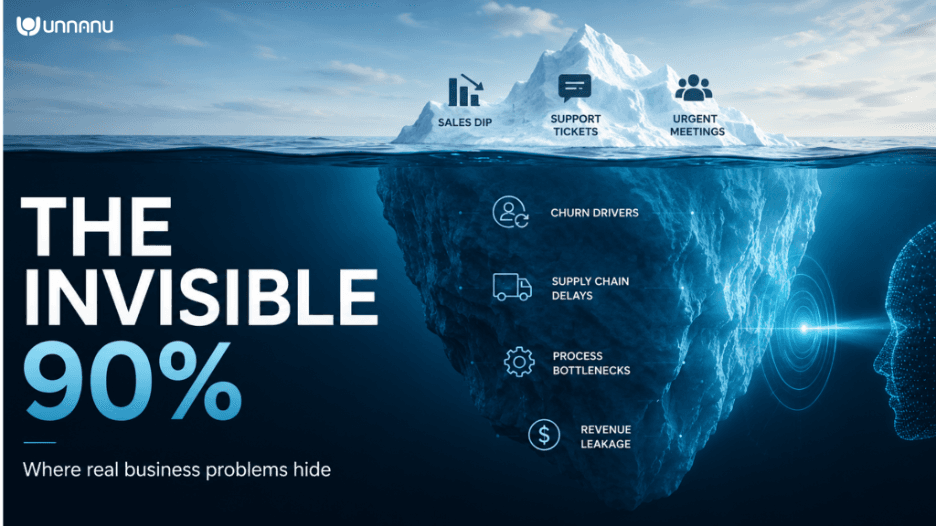
A retail company spent nine months and nearly $500,000 rebuilding their checkout flow. Conversion was down. Leadership was under pressure. A full team of designers, analysts, and consultants went to work.
Three days after running an AI audit of their entire operation, they found the actual problem.
Their delivery partner had quietly stretched average shipping times from three days to six. Customers weren't abandoning checkout because of bad UX. They were leaving because nobody on the website was telling them their order wouldn't arrive when they needed it. The checkout was fine. The supply chain was broken.
$500,000. Nine months. Completely avoidable.
This isn't a horror story about one unlucky company. This is Tuesday for most businesses.
The Real Problem Is Which Problems You Choose to See
Dwight Eisenhower had a framework he lived by: urgent and important are almost never the same thing. Charles Hummel named that trap in 1967 - the tyranny of the urgent. Stephen Covey brought it to millions. And yet here we are, every leadership team still losing the same battle every quarter.
The problems that are loud, visible, and easy to measure always win the room. A dip in a sales chart. A spike in support tickets. A system going down at 2am. They feel like emergencies, so they get treated like emergencies.
The problems actually draining your business tend to be quiet. They don't send alerts. They compound slowly for months or years while your best people are aimed somewhere else entirely.
Most organizations aren't losing money because of bad strategy. They're losing money because they're solving the wrong problems with complete confidence and total conviction. That's exactly what AI was built to fix.
What AI Sees That You Can't
AI doesn't have a favorite department. It doesn't have a project it spent eight months on that needs defending. It doesn't get tired, skip across disconnected data sets, or overlook something because it doesn't fit the story leadership already believes.
When you give AI the right data, your operations metrics, customer behavior logs, financial records, support tickets, product usage patterns, it finds what humans miss. Not because it's smarter. Because it's faster, more patient, and completely indifferent to internal politics.
Three areas where this shows up consistently:
The Revenue You're Quietly Bleeding Every Month
A software company was convinced their biggest churn problem was in enterprise accounts. Leadership could see those accounts in every pipeline review. That's where the energy went.
An AI analysis told a different story. Mid-market customers were quietly downgrading their plans between months six and seven at a rate nobody had tracked. The reason was a specific feature gap that had been showing up in support tickets for over fourteen months. Nobody had ever connected those two data sets.
That downgrade pattern cost $2.1M a year. The enterprise churn problem everyone was obsessing over? $300K annually. They were spending most of their resources on the problem worth seven times less.
The Hidden Tax Your Operations Pay Every Week
This one never shows up as a line item. Researchers call it invisible work. Approval chains that add unnecessary days to every project. Rework loops nobody tracks as rework. Coordination overhead between teams that eats hours every week and never gets measured.
A mid-size manufacturing company ran AI across their internal communications, ERP data, and project timelines as one connected picture. It flagged something precise: one supplier approval process was adding an average of eleven days to every product launch. Across a year, that silently delayed fourteen product launches, each with its own measurable revenue impact.
The fix took three weeks. Cost almost nothing. That process had been bleeding money in the background for four years.
The Customer Who's Already Decided to Leave
Most businesses wait for customers to say something is wrong. The problem with that approach is timing. By the time someone's writing a review or responding to a survey, they've already made their decision. You're reading the postmortem.
AI works much earlier. It reads behavioral signals that predict dissatisfaction before it becomes churn — where users stop engaging with a feature, how support tickets escalate in the ninety days before cancellation, which onboarding steps most closely correlate with customers who stay three years versus those who leave after six months.
Then it ranks those signals by financial impact. Your product team stops guessing. They work from a prioritized list of the highest-value problems, in order of what solving them is actually worth.
Finding the Problem Is Only Half the Job
Most conversations about AI in business focus on discovery - what can it find, what patterns can it surface. That matters. But it's honestly the easier half.
The harder and more valuable thing AI does is prioritize. It takes the problems it finds and ranks them by financial impact, so your leadership team stops having the same circular debate about priorities every quarter.
McKinsey's State of AI 2024 report found that early-moving companies deploying AI with real operational intent were already attributing more than 10% of their total EBIT to AI use — most of them under $1B in annual revenue. What separated them wasn't the technology. It was the discipline with which they chose where to apply it.
Their 2025 follow-up confirmed the same pattern. 88% of companies now use AI in at least one function. Only about a third are scaling it meaningfully at the enterprise level. The gap isn't access to AI. It's whether leaders are using it to find their most expensive problems — or just automating tasks that were already visible.
How to Start This Week - No Big Initiative Required
You don't need to hire data scientists or buy an enterprise platform to begin.
Audit what you already own. Most businesses are sitting on years of untapped operational data — CRM records, billing histories, support logs, usage analytics. This is your raw material and most of it's already collected.
Give AI a financial lens from day one. The clearest question you can ask: which patterns in our operations are most closely tied to revenue loss, rising costs, or declining customer value? Without that frame, you end up with interesting insights nobody acts on.
Build for a decision, not a presentation. The output you're looking for isn't a fifty-page report. It's a ranked list of three to five specific problems with estimated financial impact attached to each one. That's what gets acted on.
Make it a monthly habit. Problems shift. New patterns emerge. A planning cycle that reviews priorities four times a year can't respond fast enough. The organizations getting the most out of AI problem diagnosis treat it as a lightweight monthly audit, not a big annual project.
The Hardest Thing to Accept
Most businesses will keep solving the wrong problems. Not because the people running them aren't capable. Because the most expensive problems are genuinely invisible without the right tools to surface them.
The leadership team that spent a year on a digital transformation while a supply chain issue quietly drained their margins wasn't making a bad decision. They made the best call they could with the visibility they had. That's the real issue. Not judgment. Visibility.
AI doesn't replace judgment. It gives judgment something accurate to work with. The businesses pulling ahead right now aren't doing it because they have better ideas than their competitors. They're doing it because they're consistently choosing better problems to work on.
Working hard on the wrong problem isn't a noble effort. It's an expensive one.
One question worth sitting with this week:
Think about the three biggest initiatives your organization is running right now. How were those priorities chosen because data showed they were your most expensive problems, or because they were the most visible ones in the room when someone called a meeting?If you're not completely sure of the answer, that gap is worth closing.
References
Hummel, Charles E. Tyranny of the Urgent. InterVarsity Press, 1967.
Covey, Stephen R. The 7 Habits of Highly Effective People. Free Press, 1989.
McKinsey & Company. The State of AI in Early 2024. May 2024.
McKinsey & Company. The State of AI in 2025. November 2025.